

Catholic Soundbites 09 - Judaism during Gospel times

Continuing on with this series, we will now go into the life that Jesus would have encountered during his time in Palestine.
The Law

To understand the daily life Jesus stepped into, it is necessary to begin with the Law, because it shaped not only Jewish religion but also family life, education, worship, and social order. To the Jews, the Law is the defining element of their identity as a people. The Law given by God through Moses was what made them different from the peoples around them. From a young age, Jewish boys are taught to read and write so that they could recite the Law by heart by the age of thirteen and understand it enough to observe it in detail. Girls are also taught the Law, but not in as much detail, enough for them to hand it down to their children. Which is why Jesus spoke as if everyone knew the Law intimately, because they did.
The Law and the Prophets (Isaiah, Jeremiah, etc) form the Jewish Bible at that time, which were read in the Synagogue just like how we read from the Missal in church today. Most of the prophecies quoted in the Gospels came from the Prophets.
The Law is basically the Ten Commandments that God gave to Moses. The original tablets were kept in a box called the Ark of the Covenant, which the Jews gave the place of honour in the Temple (and something like it in the synagogue). These commandments were expanded into quite detailed rules in the books of Exodus and Deuteronomy. Still, it was not enough for some Jews and Pharisees produced several commentaries detailing what these rules mean in each situation and circumstance. Many Jews today believe that there are 613 such commandments, enumerated centuries after Jesus.
Jewish practices
The Law was not an abstract set of beliefs but something meant to be lived out daily, and this gave rise to a detailed pattern of religious practices that shaped every aspect of Jewish life. For instance, cleanliness is prescribed by the Law and Jews take great pains to avoid defiling themselves with something unclean. Touching something unclean, like a dead body, would render a person unclean and unable to participate in prayers for seven days. There is a list of unclean food that a Jew may not eat in the Old Testament (which the Apostles agreed did not apply to Christians). Childbirth renders a woman unclean for 40 days (80 days if the baby is a girl), during which she is to be confined for purification. Some of the laws actually make hygienic sense, like not touching a leper.

Jewish practices other than observation of the Law were prayers, fasting and alms giving, which Jesus constantly referred to. Jews were required to pray three times a day; at the third hour (morning), sixth hour (noon) and the ninth hour (early evening). They would wear prayer shawls, some with tassels that aid in prayers. Also, phylacteries (small boxes which contain passages from the Law) are tied to their arms and forehead.
While there is only one day of obligatory fasting for all Jews on the Day of Atonement (known as Yom Kippur today), private fasting is common. Pharisees, for instance, fasted on Monday and Thursday, a practice which the early Church followed with fasting on Wednesdays and Fridays. Our fasting on Fridays is mild in comparison, as Jewish fasting is similar to the Muslim Ramadan fast of total abstaining from food and drink from sunrise to sunset.
All Jewish boys are circumcised at the age of eight days as a sign of the Covenant with God as part of his Chosen People. In addition, all firstborn boys are to be offered to God as Abraham sacrificed Isaac when God commanded him to. These boys are redeemed by the family in exchange for a sacrifice offering of a lamb (or a dove for poor families) and we celebrate this on February 2 on the Feast of the Presentation of the Lord. Interestingly, Jews consider that the lineage of Judaism is matrilineal, meaning that you are a Jew if your mother (not father) is a Jew.
Jewish Temple
While these practices governed daily religious life, the heart of Jewish worship during the time of Jesus was found not in the home or synagogue, but in the sacrifice at the Temple. Jewish sacrifices can only take place in the Temple and can only be performed by Jewish priests, who all descend from the line of Aaron, the brother of Moses. As there is now no longer any Temple, there is now no longer any Jewish priests or sacrifices. But at the time of Jesus, sacrifices (called Korban or 'burnt offerings' in the Bible) of a sheep or a bull were offered daily, every Sabbath and on feast days, each with its own ritual. In addition, sacrifices were also offered for the birth of a child, in thanksgiving, to atone for a sin or in fulfilment of a vow. Poor people may offer a dove or grain instead.

The first Jewish Temple was built by Solomon but was destroyed during the Babylonian exile and rebuilt when the Jews returned to Jerusalem. In 20BC, Herod the Great renovated and greatly enlarged the Temple to a huge walled enclosure measuring 75m by 175m on a flat square some 480m by 300m. It was magnificent to see and its 20-storey high walls were reportedly gleaming white. It took 8 years to stockpile the material before construction continued until just six years before its destruction by the Romans in 70AD. So, by the time of Jesus, it was already 46 years in building, with a further 30 more years to go.
Because sacrifice was central to Jewish worship, the physical layout of the Temple was carefully designed to reflect increasing levels of holiness. By the time of Jesus, this vast and magnificent structure had developed a complex layout that regulated who could approach God, and how closely. You approach the Temple via the Eastern Gate or one of the Southern Gates. The outer part of the Temple is the outer courtyard that is open to all people, and so is sometimes known as the Court of the Gentiles. A rail separates off the part that non-Jews are not allowed to enter and through the Beautiful Gate, you arrive at the Court of Women (where 13 alms-boxes are available for contributions - the same one that Jesus saw the poor widow dropping in her two coins), the Court of Israel (which only men may enter to pray and where they hand over their offerings to the priests) and the Court of Priests, where the Altar of Burnt Offerings is located.
The altar is in front of a building called the Sanctuary, 11m by 5m, and has two rooms. The first room, the Holy Place, has an altar, the twelve bread to represent the 12 tribes of Israel (the bread that King David ate when he couldn't find any other) and a seven-branched Jewish candelabra.
The smaller Holy of Holies is reserved for the Ark of the Covenant but by the time of Jesus, it was
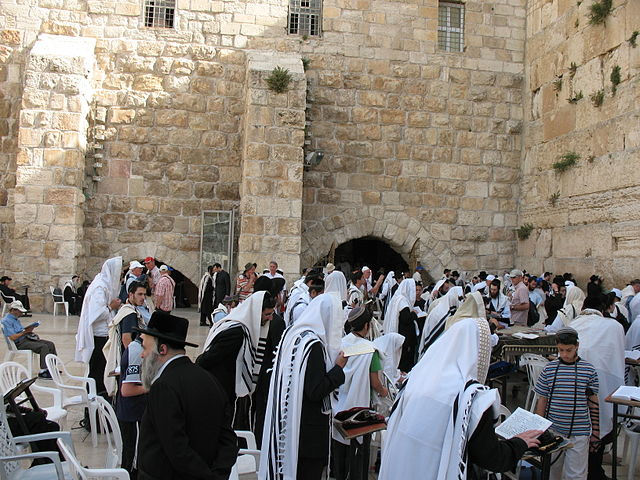
empty, as the Ark had been lost. It is in the Holy Place that a priest is chosen by lot to burn incense every day (this was where Zechariah, father of John the Baptist, was struck dumb) while only the High Priest was allowed to sacrifice in the Holy of Holies one day a year.. A curtain separates the two rooms and this was the veil that was torn in two when Jesus died. Today, only one wall is left, called the Wailing Wall and Jews are often seen praying there.

A few feasts were mentioned in the Gospels. The Passover is the most important of Jewish feasts and is equivalent to our Easter. It happens around the same time because it is calculated using a formula similar to Easter. It commemorates the Israelites' deliverance from Egypt under the leadership of Moses. A sacrificial meal is eaten by the family at home (together with any guests from out of town that Jewish families were encouraged to host for this meal) with food, prayers and conversation designed to bring the story of the Exodus to mind. The Last Supper that Jesus had with his disciples was one such Passover meal, but he introduced many practices to institute the new worship of the mass. A Passover sacrifice of a lamb is also offered in the Temple, which Jesus replaced with his sacrifice on Passover day.
Pentecost is a Jewish feast day of thanksgiving celebrated fifty days after Passover, when it is customary for Jews of the diaspora to make a pilgrimage to Jerusalem, although pilgrimages were common on other feast days as well. Normally, only those living near Jerusalem will go to the Temple for Passover, as most would be celebrating the Passover meal with their families.
The Feast of the Atonement (known as Yom Kippur) mentioned by Jesus is a day of penance to atone for sins. It is also the day that the High Priest would sacrifice blood into the Holy of Holies before driving a he-goat, burdened with the sins of the people, into the desert - hence our term 'scapegoat'.
The Feast of Tabernacles is a week-long feast to recall the fragile tents that the Israelites lived in the desert. During this week, Jews are supposed to build huts of branches or tents to live and pray in. Rituals include the drawing of water to the altar just as their ancestors did in the desert and Jesus alluded to this by calling himself the 'spring of living water' during this festival.
The Feast of Dedication (or Hanukkah) commemorates the rededication of the Temple by Judas Maccabees.
The synagogue

Much as the parish church is the centre of life of the Christian community today, the synagogue is the centre of Jewish life. While the primary place of worship for Jews is the Temple, the synagogue became the place of gathering for Jewish worship in places far from Jerusalem. In some ways, the layout of the synagogue mirrors that of the Temple, with the innermost part being where the Torah (the Law) is kept, like the Ark in the Temple. The place for women is the outermost part of the synagogue, away from the men.
While Jewish men may go to the synagogue to perform their three times daily prayers, the communal prayer session is the Sabbath service, lasting an hour in the afternoon. It is similar to our Liturgy of the Eucharist, which models itself on the Sabbath service: Opening prayers, Readings, Homily.
The synagogue is also the place for Jews to meet (the elders of one such synagogue reported to Jesus that it, the 'meeting house', was built by a Roman officer) as well as the school where Jewish children learnt to read & write as well as study the Law.
Jews see the Sabbath as Judaism's first and most sacred institution mandated by the Law. It celebrates Saturday as the last day of the week of creation when God rested. No, God did not rest on Sunday. Sunday is the first day of the week when Jesus rose from the dead and Christians

celebrate the Sabbath on Sundays because Jesus rose on that day, not because God rested on that day.
Sabbath rituals start with the evening meal on sunset of Friday. The Jewish day starts on sunset of the day before and the Church has continued this practice - this is why Saturday sunset mass counts as Sunday. There are two more ritual meals on Saturday, as well as the synagogue service in the afternoon.
Jewish law prohibits a number of activities during the Sabbath, 39 categories by modern day count, largely under the prohibition against work but includes such activities as travelling or transporting an object, lighting, tending or extinguishing a fire. These activities are not in the Bible but are interpretations by Jewish rabbis like the Pharisees in Jesus' days. There is now a complicated body of rules detailing what is allowed and what is prohibited on the Sabbath under Jewish law. Even today.
For instance, today, 'lighting a fire' includes switching on anything electrical because an electrical switch closes a loop to the fires in the power station. This is why elevators in Israel are programmed to stop on all floors on Saturdays so that no one needs to press any buttons. I remember once wandering around the Jewish quarter in London one Saturday when a little Jewish boy (with his braided hair and all) came up to me and asked me to ring the doorbell for him, because he couldn't touch the electrical doorbell - up until then, I thought laws of the Pharisees were only in the Bible and history books.
Today, orthodox Jews do not drive on Saturdays because it violates the rules against travelling, touching anything electrical and lighting a fire (in the internal combustion engine). Expect stones to be thrown at your car if you drive past some Orthodox Jewish neighbourhoods in Israel. Prohibitions against travelling were one of the many reasons why Jewish quarters arose in many cities, so that everyone could just walk to the synagogue on Saturdays, though discrimination was a much larger driving force for Jewish ghettos.
The injunction against transporting objects defines the unacceptable distance as about 1km in public areas or from private dwellings to public areas, as well as detailed definitions of which are private areas and which are public areas. This has led to buildings and public courtyards being designed so that private dwellings can be declared public areas by way of, say shared walls while keys were incorporated into their clothing so that they become part of garments not covered by the law, instead of items to be transported.
Conclusion
It should be noted that while the Pharisaical definition of the Law had widespread support among the Jews at the time of Jesus, it was by no means the only way Jewish life was practised. There were other traditions, including the Sadducees mentioned in the Bible and the Essenes. The Sadducees controlled the High Priesthood and the Temple ritual and became extinct after the destruction of the Temple. The Essenes, on the other hand, were austere to the point that they withdrew into the desert, where their Dead Sea Scrolls, discovered in 1946, lit our understanding of Jewish thinking during Biblical times. Today, just as in antiquity, Jewish thought is diverse, even if they share a common theme of the Law handed down by God. Then, as now, Jews argued incessantly over every detail. There is a saying in Israel: Ask three Jews a question and you get five opinions.
In Jesus' days, such rules were still being developed and many were not yet all that old. It was against this background of increasingly detailed Sabbath regulations that Jesus’ teaching and actions provoked controversy. Understanding these laws and practices helps explain why Jesus’ words and actions were so striking: he did not reject the Law, but challenged how it was being used. Jesus questioned the objectives of such rules as to whether religion is meant to liberate people or to add to their burdens.


Comments